
The 2026 Hannover Shanghai industrial fairs ran on 3–6 November at the Shanghai New International Expo Centre, built around PTC ASIA, CeMAT ASIA and ComVac ASIA with eight linked shows. Pudong Times reports nearly 220,000 m² of exhibition space, close to 2,900 companies and an expected 140,000 trade visitors; Xinhua reports close to 3,000 companies and the same visitor expectation.
ComVac ASIA, themed “intelligent, efficient, low-carbon”, covered nearly 30,000 m² with close to 350 exhibitors in its 20th edition, alongside 30-plus forums and seminars (Pudong Times). The 6 November closing report states the next edition will be ComVac ASIA 2027.
The change in evaluation criteria is the story
In the closing coverage, exhibitor representatives said the market’s yardstick has moved from comparing single-machine parameters to assessing whole-station energy efficiency. That aligns with the MIIT plan’s call for “system coupling and matching”: users no longer ask only for airend specific power, but for the total kWh per standard cubic metre across the station.
How system efficiency lands in a real project
- Count the pressure drop: losses in drying, filtration and pipework are ultimately paid for by extra work at the compressor.
- Match control to the load curve: inverter control for fluctuating demand, two-stage for steady full load, and a large/small pairing for mixed duty.
- Size the receiver for peak shaving: correct volume reduces load/unload cycling — a saving that is often overlooked.
- Keep operating data: without metering there is no verification, so data logging belongs in the technical agreement.
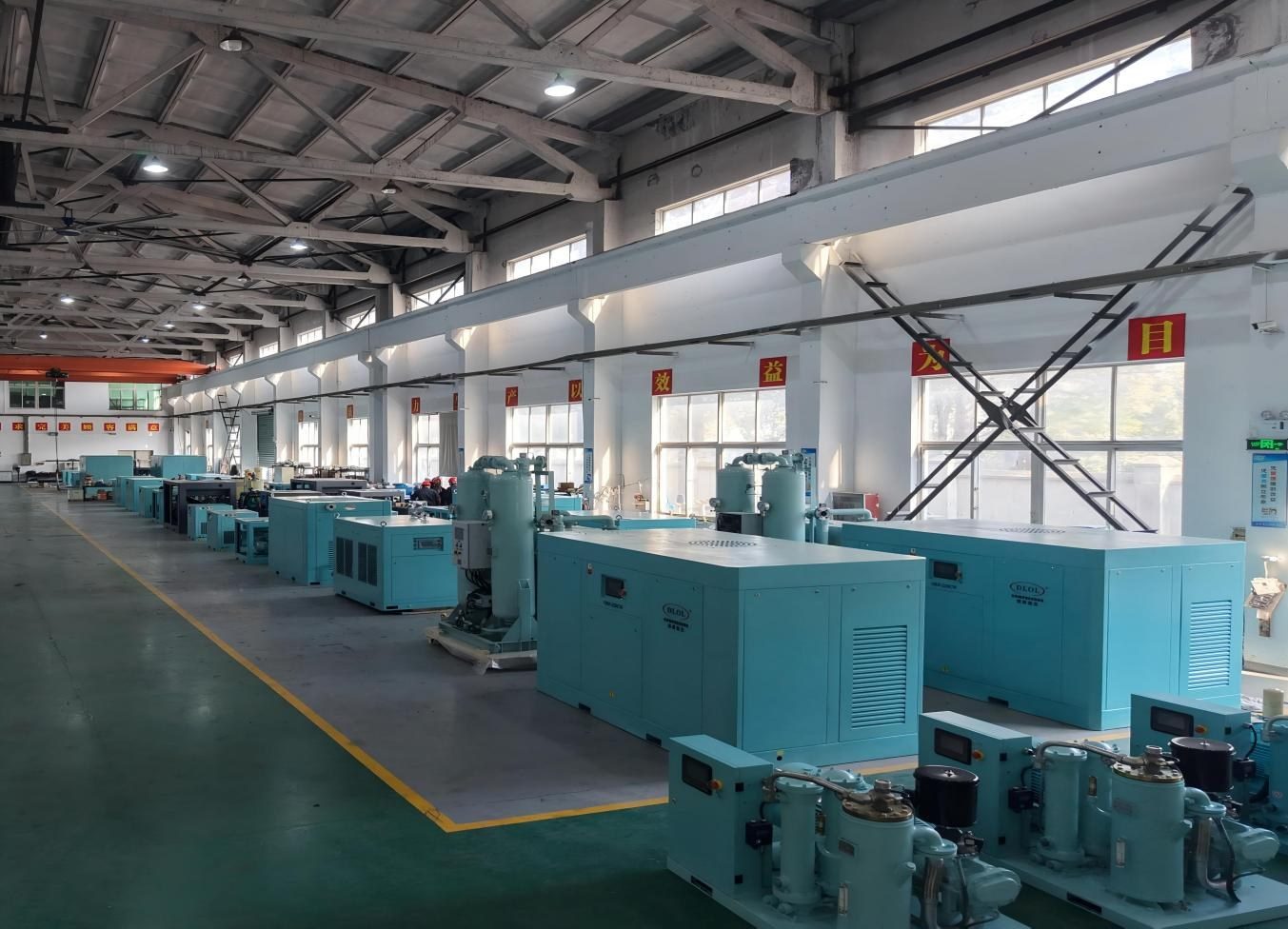
That is exactly the thinking behind Shengyi’s 4-in-1 and 5-in-1 packages: host, receiver, dryer and filters matched to one duty and jointly tested before dispatch, reducing the pressure drop and interface errors that come with site assembly.
At a glance
| System stage | Typical loss source | Improvement |
|---|---|---|
| Airend | Unload and throttling losses; high single-stage ratio | Choose inverter or two-stage by load curve |
| Treatment | Dryer and filter pressure drop raises the set point | Stage to the ISO 8573-1 class; avoid over-filtration |
| Receiver | Undersized volume causes frequent load/unload | Size from peak flow and allowable pressure drop |
| Pipework | Undersized lines, bends and leaks | Verify true end-user pressure, then lower the set point |
| Metering | No data, no verification | Put logging and remote reading in the technical agreement |
Frequently asked
What is station-level efficiency?
The total kWh per standard cubic metre delivered by the whole station, including airend, treatment, receiver and pipework losses — not just the specific power on the nameplate.
Why is swapping the airend alone limited?
Pressure drop in drying, filtration and pipework is paid for by extra compressor work. If system losses absorb the efficiency gain, station consumption barely falls.
How is receiver volume set?
From peak flow and allowable pressure drop, not estimated from compressor power. Correct volume reduces load/unload cycling — an often-overlooked saving.
What is the benefit of a 4-in-1 package?
Host, receiver, dryer and filters matched to one duty and jointly tested before dispatch reduce site-assembly pressure drop and interface errors — but selection still follows the actual load curve.
Sources
Facts and figures are quoted from the public reports below; the commentary is our own analysis.
- (in Chinese) (in Chinese) 2026-11-05 Read the source
- (in Chinese) (in Chinese) 2026-11-05 Read the source
- (in Chinese) (in Chinese) 2026-11-06 Read the source
Images are Shengyi own photographs; no third-party images are reproduced.
Author:Shengyi Technical Department Reviewed by:Mr. Zhang (Sales & Sizing) Updated 2026-11-06